What is a Palatal Expander?
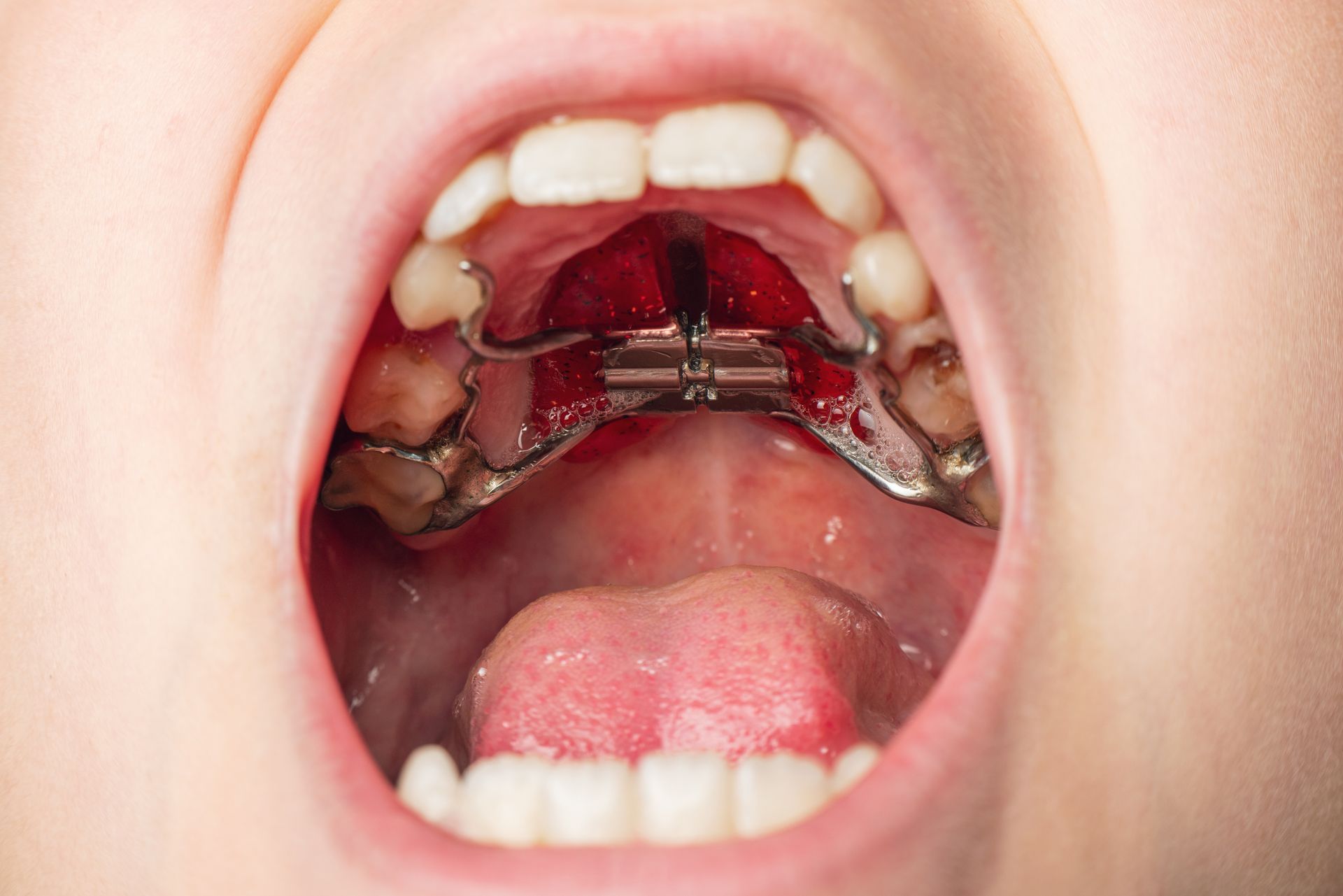
A palatal expander or a palate expander is a custom-made mouth appliance that is designed to
gradually widen the upper jaw. The device anchors onto the back molars with small metal
bands, and then runs along the roof of the mouth where a small keyhole in the middle allows for
the device to be cranked incrementally.
The reason a palatal expander is effective on children is because everyone has two palatal
bones that don’t typically fully fuse together until the mid teenage years. What an expander
does is it applies slow and controlled pressure to the back molars, pushing apart these two
palatal bones that haven't fully fused. This allows new bone to form in the newly created space,
ultimately making the jaw wider. This is why it’s important to identify a narrow upper jaw early.
Most children wear a palatal expander for about 6 months, with a period of active expansion
(turning the key daily or as instructed), followed by a stabilization period where the device stays
in place, allowing for the bone to fully solidify.
What is a Palate Expander Used For?
When people hear the words palate expander they often know it’s used to create more space,
but apart from that, what is a palate expander used for? What makes it such an important
orthodontic treatment option?
There’s actually quite a few benefits of widening a narrow upper jaw that can drastically improve
your child’s future oral health. So let’s get into them!
Creating Space for Crowded Teeth
This is the most obvious one. When the upper jaw is too narrow, there’s simply not enough
space for a person’s permanent teeth to come in. Expansion creates more space, and allows for
teeth to be guided into better positions more naturally.
Correcting Crossbites
A crossbite is where some of the upper teeth sit inside of the lower teeth. This issue can lead to
uneven tooth wear, jaw pain, and facial asymmetry. Luckily it can be corrected by widening the
upper jaw, so that the upper teeth sit properly aligned with the lower teeth.
Improving Bite Alignment
When the upper and lower jaw don’t fit together as they should it can be uncomfortable, painful,
and make certain daily functions, like chewing, difficult. If left untreated, it can also worsen or
cause long-term problems that are more difficult to treat.
Supporting Healthy Jaw Growth
By intervening early, when it’s clear there’s a problem, an orthodontist is able to guide your
child’s jaw development instead of needing to correct problems later. In orthodontics, prevention
and guiding growth are almost always going to be better options than correcting a problem later
through more complex and costly treatments.
Helping Airway Development
For some patients, a wider upper jaw can actually support better nasal airflow. This can be
important because if certain airway issues are left unaddressed they can manifest into a wide
range of problems from mouth breathing, to poor sleep quality, to changes in facial growth
patterns.
Palatal expanders are a common part of orthodontics for children, because they offer a
non-invasive way to guide growth and help prevent more serious issues from developing down
the line.
Types of Palatal Expanders
There isn’t a one-size-fits-all expander and your orthodontist will choose whichever is right for
your child. There are two main categories of palatal expanders:
Fixed Expanders
Fixed palatal expanders, also referred to as rapid palatal expanders (RPE), are the most
common type of expander for children. They attach to the molars and stay in place throughout
treatment. Parents are then responsible for consistently turning the key at whatever frequency is
instructed by the orthodontist.
Removable Expanders
Removable palatal expanders offer, as their name suggests, an option that can be taken out.
They are used in specific situations, such as when small adjustments are needed. Even though
they’re removable, they should still be worn 24 hours a day, as consistent pressure on the teeth
is necessary for a successful outcome.
Your orthodontist will work with you to determine which of these orthodontic treatment options is
right for your child.
Benefits of Using Spacers for Teeth
People will sometimes get confused and think that spacers for teeth and palatal expanders are
the same thing, when in reality, they have completely different uses.
A palatal expander is used to widen the upper jaw, creating more space and improving how the
bite fits together.
Spacers for teeth, on the other hand, are small devices placed between specific teeth, creating
small gaps so that orthodontic bands or appliances can be placed without having to use a lot of
force.
Orthodontic Treatment Options For Children
We talked about this at the beginning, but it’s worth highlighting again: even if everything looks
fine with your child’s mouth, an early evaluation around the age of 7 can be really important.
That's why the American Association of Orthodontists recommends that every single child be
evaluated by an orthodontist at age 7. A lot is changing during this time, as the jaws develop
and adult teeth start to come in, and an orthodontist can spot early signs of crowding, bite
issues, or jaw development concerns.
Catching problems early often means that simpler, more non-invasive treatment options can be
used. Instead of waiting for an issue to fully develop, your orthodontist can guide growth and
make space in more natural ways. On the flip side, if a problem is left unchecked, it can develop
into a much bigger problem that is more difficult to correct. Treatment can go from something
simple and painless to something complex, invasive, and expensive.
A palatal expander is one example of a tool that is used in orthodontics for children, but it’s not
the only one. Depending on what issues are detected during your child’s orthodontic evaluation,
there are a bunch of other orthodontic treatment options that may be recommended.
- Simple monitoring of jaw growth and tooth eruption over time
- Habit appliances (for things like thumb-sucking)
- Growth guidance appliances- Limited braces or phase 1 treatment
An early evaluation doesn’t automatically mean that your child will need treatment. In many
cases, the orthodontist will just keep an eye on development and step in only when it becomes
necessary.
Conclusion
If your child is 7 years or older, and you’re unsure whether they could benefit from a palatal
expander or another form of early orthodontic treatment, the best step you can take is
scheduling an initial free consultation.
Many parents start their hunt for a quality orthodontist with a quick search of “orthodontist near
me,” but choosing the best orthodontist for your child isn’t just about location. What’s more
important is finding a practice that’s going to truly have your child’s best interests in mind, and
that takes a thoughtful and growth-focused approach to care.
At Cardall Orthodontics in Bakersfield, early evaluations help us establish a baseline for your
child’s oral health and development. From there, we can carefully determine if treatment is
needed, and if it is, when it should take place. Our goal is to guide growth at the right time,
taking a proactive, but never rushed, approach to orthodontics. This makes for simpler future
care and yields stable, long-term results.
Set up an early evaluation today, and we’ll make sure that whether your child needs a palatal
expander, some other form of orthodontic care, or just simple monitoring, they’re on the right
track!